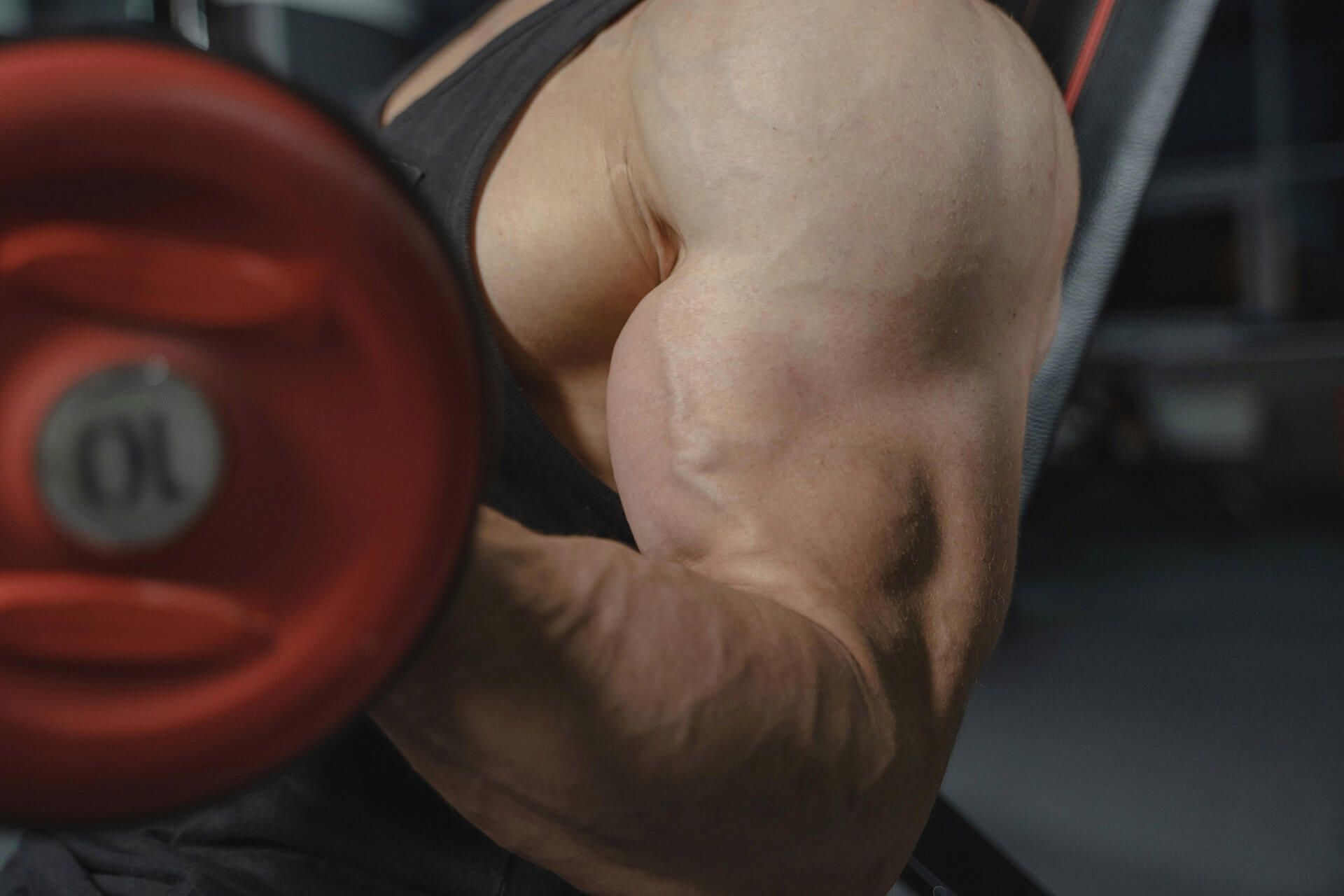
Your Glutes Are Weak. Here's Why That's a Problem After 50.
Why Glutes Matter More Than You Think
Most people over 50 default to cardio. Maybe some upper body work. But they haven't thought about their glutes since... well, ever.
That's the problem.
Women tend to do the opposite. In fact, I've heard other personal trainers say they wish women trained their upper body more and men trained their lower body more.
But your glutes aren't a vanity muscle. They're the largest and most powerful muscle group in your body.
And for desk-bound people, that engine has been underperforming for years.
When you sit for long periods, the muscles at the front of your hip, your hip flexors, shorten and tighten up.
When hip flexors are tight, your nervous system sends the glutes a message to stand down. This is called reciprocal inhibition. It happens because your nervous system prioritizes efficiency and joint safety.
It prevents opposing muscles from pulling hard at the same time. When one side is overactive and tight, the opposite side goes quiet.
And here is where it gets interesting…
When glutes go quiet, your body doesn't stop moving.
It finds a workaround.
This is called synergistic dominance. Your glutes are the primary movers for hip extension (the movement that powers walking, climbing stairs, and standing up), so when they check out, your brain calls in the backup muscles (synergists) for help.
Your quads take over.
Your lower back steps in.
Your hamstrings get busy.
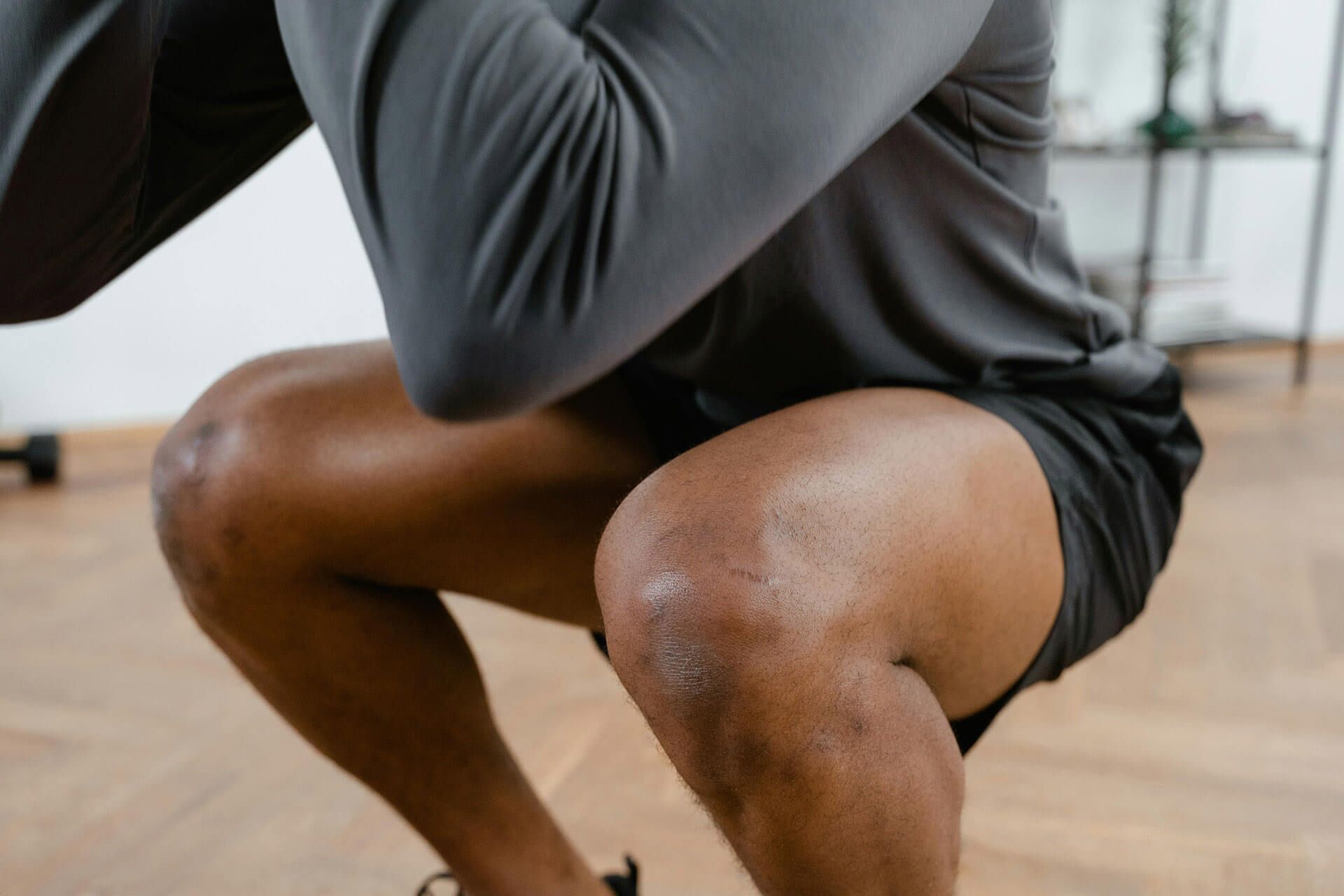
When quadriceps or "quads", your front thigh muscles take over, they pull the kneecap upward and out of alignment. The result is the grinding, aching knee pain that people over 50 chalk up to age. It's not age. It's mechanics.
When your lower back compensates, people often arch their back, leading to a lot of force on the spine. Not good!
And the hammies? Yikes. Watch out! The hamstrings are the most common muscle to take over for the glutes in hip extension. They get overworked, which can lead to painful tightness and even strains.
These muscles are doing stuff they weren't designed for, because your body is very, very good at compensating.
But you pay a price for it!
Secondary muscles become overworked and tight.
Your posture shifts.
Your lower back aches.
Your pelvis tilts forward.
Your injury risk climbs.
And… it sneaks up on you.
This is why you can squat regularly for years and still have weak glutes.
The squat looks fine, but your body has rerouted the work to muscles that were never meant to handle it. (Remember, the body is remarkably good at compensation!)
That's the problem we're here to fix.
Your Glute Anatomy in Plain Language
You've heard me say "glutes." But there are three muscles under that name. Here's what they're called, where they are, and why each one matters...
Gluteus Maximus: the largest muscle in the human body. Your butt! Covers the entire posterior of the hip. This is the power generator. We'll call it the glute max from here on.
Gluteus Medius (Glute Med) sits on the outer hip, tucked under the glute max. You can think of it as sitting just above and to the side of your back pocket. It's the stabilizer, the muscle responsible for keeping your pelvis level every time you take a step.
The glute medius is responsible for hip abduction. It moves your leg out to the side, away from the midline of your body. Every time you step sideways, get out of a car, or shift your weight onto one leg, the glute medius is hard at work.
The glute medius doesn't work alone. It's part of a group called the hip abductors, which also includes the glute minimus and the TFL (tensor fasciae latae). These muscles move your leg away from the body, rotate it at the hip, and keep you stable every time you take a step or stand on one leg.
Weakness here shows up as pain, poor movement, and a gait that's slowly falling apart!
The TFL sits at the very top and outer edge of your hip, just in front of the glute med, and runs down into the IT band. It assists the bigger muscles but isn't built for primary duty.
When the glute med goes quiet, the TFL gets overloaded. And that's when IT band problems and hip pain start showing up.
Gluteus Minimus: the deepest of the three, sitting beneath the glute med on the outer hip. Think of it as the glute med's smaller, hidden partner, buried a layer deeper. It assists with hip abduction and helps rotate the leg inward.
You can't feel it directly, but when it's strong, your hip stays stable in ways that show up everywhere from walking to single-leg squats.
If you want a thorough description of this complex, this Gluteal Muscles video from Sam Webster is one of the best I’ve found.
This Is What Your Glutes Do. No Wonder Everything Hurts When They Stop.
The glute max is the primary driver of hip extension. Every time you stand up from a chair, climb stairs, accelerate your walk, or pick something up off the floor, the glute max is working.
It's your body's big ol' movement engine.
It also controls your pelvis and trunk during rotation, and here's the part most people never think about: Glutes act as your body's built-in brake. When you decelerate, change direction, or absorb impact, the glute max lengthens and catches you.
Without a strong glute max, your hips, knees, and lower back take the brunt of the impact.
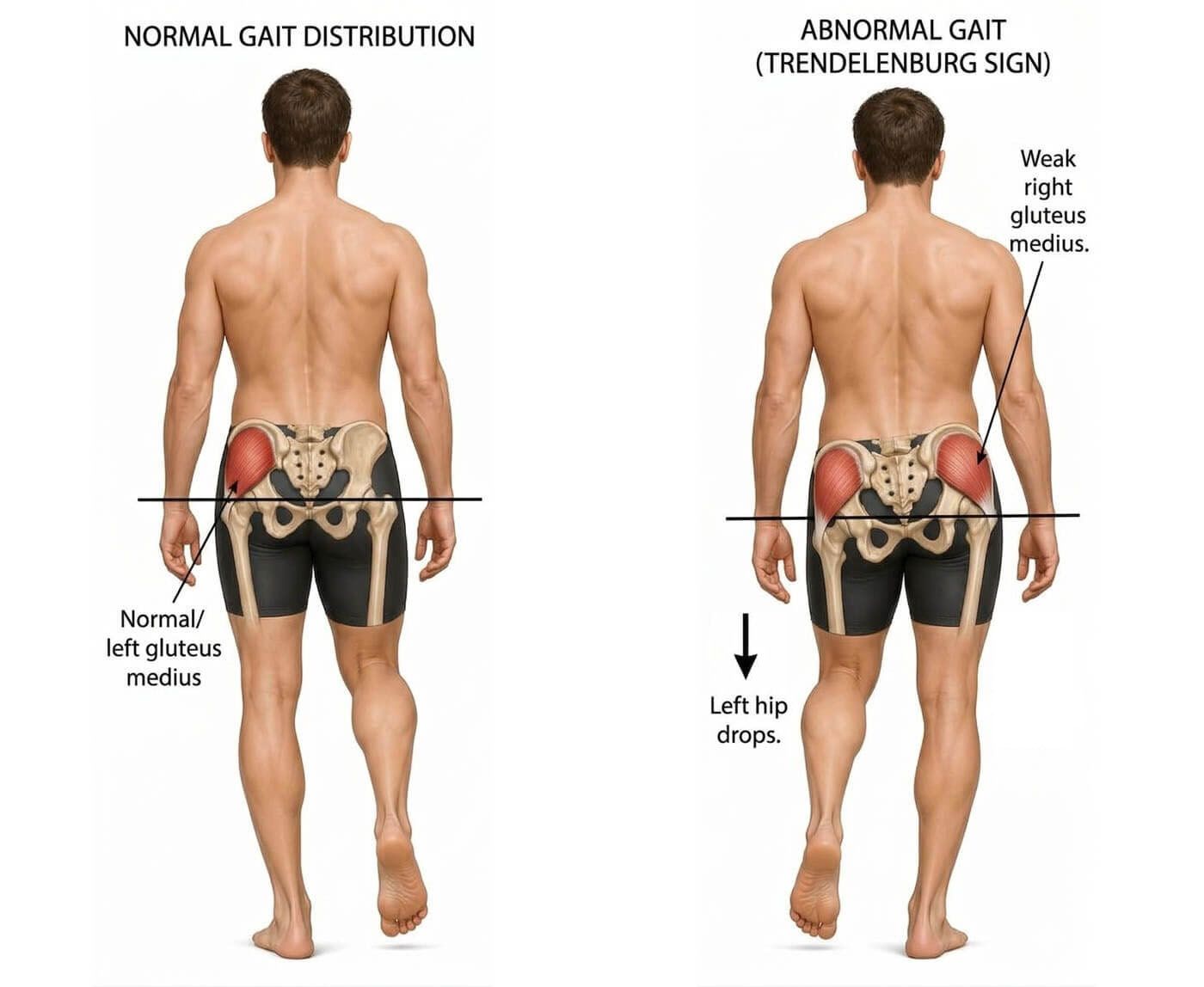
The glute med stabilizes your pelvis during every single step you take. When it stops doing its job, the opposite hip drops.
The knee caves inward. We call this Trendelenburg gait, and the diagram below shows exactly what that looks like.
Normal on the left. The drop on the right. That pattern, repeated thousands of times a day, is behind knee pain, hip pain, and lower back pain that people over 50 write off as inevitable.
For a comprehensive look at a mix of glute med exercises, take a look at this
How to Train Your Gluteus Medius video.
Why Your Glutes Stop Working
Sitting all day does several things. It tightens your hip flexors and lower back muscles. And it puts your glutes into a kind of forced hibernation.
Researchers call this lower crossed syndrome (you might call it swayback posture). But the visual is simpler... tight in front, asleep in the rear.
Here's the pattern...
Overactive and tight:
Hip flexors. the iliopsoas (iliacus and psoas major) and the rectus femoris (the kicker's muscle, actually a hip flexor AND knee extensor). These shorten when you sit for hours and pull the pelvis forward.
Lower back muscles. Specifically, the lumbar extensors, which compensate by over-arching to keep you upright.
Underactive and weak:
Hip extensors. Primarily, your glute max and hamstrings, which are supposed to counterbalance the hip flexors, but stop firing from disuse.
Deep core stabilizers, such as the transverse abdominis, multifidus, and internal obliques, lose their ability to hold the pelvis in neutral when the surrounding muscles stop doing their job.
The result is a forward pelvic tilt. Your butt sticks out, your lower back arches too much, and your stomach pooches forward. It's a posture problem driven by muscle imbalance, not age.
The glute max and glute medius are among the most commonly underactive muscles in the body, especially in people who sit at a desk all day.
A big part of the fix is to wake up your glutes!
Sound Familiar?
Years of sitting. Limited hip movement. Glutes that have checked out.
The warning signs are hard to miss once you know what you're looking at... chronic lower back tightness, knee pain without a clear injury, hip pain during or after exercise, and an inability to feel your glutes working during squats or lunges.
The glutes are weak, underactivated, and covered by the lower back and hamstrings.
Think of it as a bad connection between your brain and your butt.
Dormant glutes don't automatically wake up just because you start squatting.
Your body reroutes the work to other muscles. Your lower back. Your hamstrings. Your hip flexors. The glutes just sit there, uninvited to the party.
That's why activation work before lifting isn't optional. Band walks, clamshells, and glute bridges, done before squats and deadlifts, re-establish the signal. Reminding your nervous system how to find and fire your glutes.
Let's Work Your Glutes
I've explained the problem. Now let's fix it. Five exercises that will wake up your glutes, rebuild the connection between your brain and your backside, and make everything else work better. If you're over 50 and want to start lifting weights, pay attention...
1. The Hip Thrust: The Gold Standard for Glute Development
When it comes to building the glutes, hip thrusts are king, and research backs it up.
Bret Contreras is a leading authority on glute training. His research shows that hip thrusts produce higher muscle activation in the glute max than any other exercise, including squats, deadlifts, and lunges.
Muscle activation is how hard and fully the muscle is working during the movement. More activation means more stimulus for growth and strength.
Here's why this matters after 50. Squats and deadlifts are awesome, and we'll get to them, but they actually reduce tension on the glutes at the top of the movement, right when your hip is fully extended and straight.
The hip thrust loads the glute maximally (see what I did 😉) at full hip extension, meaning at the exact moment your hip drives forward and your body is fully straight, which is the position your glute is strongest and most capable of producing force.
And for people over 50, there's more good news. Yay!
The hip thrust requires no heavy spinal loading, no barbell on your back, and no complicated balance requirement.
You set your upper back against a bench, place a barbell or dumbbell across your hips, drive through your heels, and squeeze hard at the top. It's one of the most joint-friendly ways to load the glutes progressively over time.
If you do nothing else from this article, do hip thrusts.
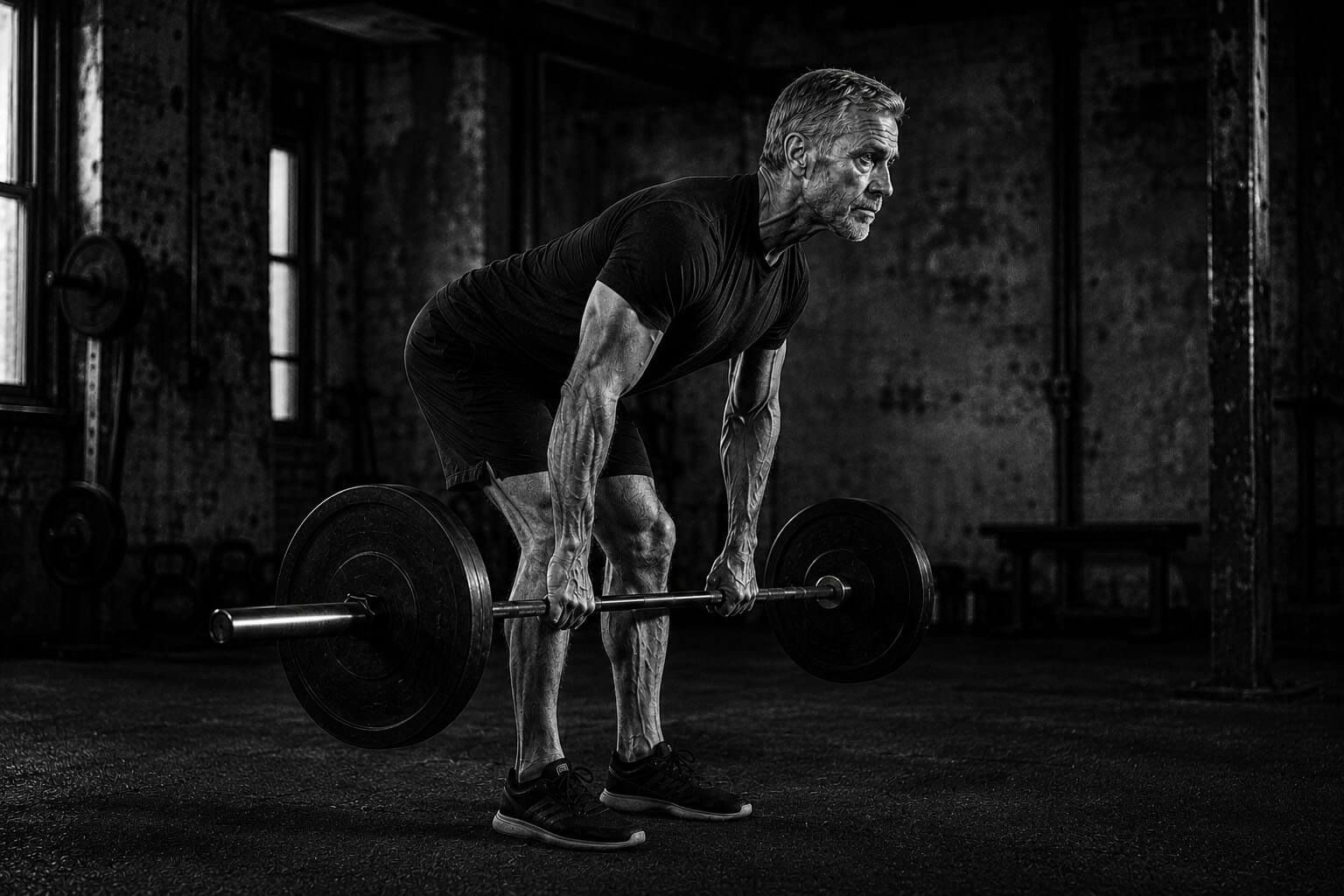
2. The Romanian Deadlift: Teaching Your Body to Hinge
The Romanian Deadlift (RDL) trains the glute max in its lengthened position. What's that mean in plain English? As you hinge forward and lower the weight, your glute stretches, like a rubber band.
That stretch under tension is one of the most powerful signals for building muscle and strength. It's also one of the most underused training positions for folks over 50.
Most people think of strength training as the work you do when you're pushing or pulling.
But some of the most important muscle building happens on the way down, when the muscle is lengthening and resisting the load.
The RDL puts your glute max and hamstrings in that position.
Beyond muscle building, the RDL teaches the hip hinge, bending at the hip with a neutral spine.
This pattern carries over to almost everything you do in real life: picking something up off the floor, loading luggage into an overhead bin, lifting a grandchild.
As I wrote in The One Lift That Keeps You Strong, Upright, and Independent After 50, the hip hinge may be the single most important movement to work on as you age.
One thing worth remembering: on the way back up, think "push the floor away from you" rather than "pull the weight up."
That small mental shift moves the work from your lower back to your glutes and hamstrings, exactly where you want it.
3. The Split Squat: The Single-Leg Movement Everyone Over 50 Should Master
Most people train both legs at the same time, squats, leg presses, deadlifts. That's fine.
But bilateral movements (using both legs) have a hidden problem... your stronger side quietly covers for your weaker side, every single rep, every single set.
The imbalance never gets exposed. Which means, it compounds over time.
Single-leg training fixes this!
Jeff Cavaliere of Athlean-X, one of the most respected strength coaches in the game, is clear on this. Single-leg movements expose the asymmetries that exercises using both legs mask.
They force each leg to do its own work, build independent strength, and stabilize the hip without help from the other side.
AND most real-world movements… walking, climbing stairs, stepping off a curb, happen on one leg.
It's training that reflects how your body moves in real life.
Over 50? The standard dumbbell split squat is the place to start. Back foot stays on the floor, dumbbells at your sides, front knee tracks over the toe, and you drop straight down.
It’s controlled, joint-friendly, and quickly reveals your weak link. Watch for two things: the knee caving inward or the hip dropping on one side. Both are signs you need to shore up your lateral stability by strengthening the glute medius, glute maximus, and adductors. (You can find split squats in Dumbbell Fitness Made Simple.)
Once the good ol’ split squat feels solid, the Bulgarian Split Squat is the natural progression.
Back foot elevated on a bench, more load forced onto the front leg, deeper range of motion, more tension on the glute max and quad.
Cavaliere calls it his single favorite leg exercise for a reason. It's harder to balance, harder to execute, and harder... exactly why it produces more results.
Start with the split squat.
Then, move on to the Bulgarian.
4. The Lateral Band Walk: Simple, but Essential
Lateral band walks target the glute med, the smaller muscle mentioned earlier that sits on the outer hip and keeps your pelvis stable when you're standing on one leg. Most people don't work their lateral stabilizers, but need to!
Band walks sound easy. BUT... the first time you do it with real tension and real form, you'll discover muscles you forgot you had.
This builds lateral hip stability. You'll climb stairs better, find you're more stable while hiking, and your knees will be happier.
It's one of the best low-impact movements you can do, both as a warm-up primer before heavy lifts and as a standalone workout.
You need a flat loop mini resistance band for this. You'll want a few different tension levels because the right tension depends on your strength and where you place the band. Experiment.
Band placement matters.
Hinge slightly at the hips, bend your knees, and walk sideways. You'll feel it in the outer hip, and that's exactly where you want to feel it!
Keep your body centered throughout. Don't lean side to side. And keep constant tension in the band throughout.
Start with the band around your ankles. Research shows ankle placement produces the highest glute med and glute max activation.
If ankle placement is too difficult, or if your knees are caving inward, move the band just above the knees.
Knee placement provides feedback that helps keep your knees tracking properly. Use it as a starting point, then work your way down to the ankle as you get stronger.
Three form cues that make a BIG difference:
Slight bend in the knees throughout. Never lock out. Never let your knees cave inward.
Step sideways with control and don't let your feet slap together between reps.
Never let your feet fully come together. Constant band tension is the whole point.
5. The Goblet Squat
The squat is the foundation of lower-body training. It works the glutes, quads, and core together. But if you're over 50, jumping straight to a barbell squat isn't the best starting point.
The goblet squat is.
When I start a client on squats, this is where we begin.
Here's why it works so well.
Holding a weight in front of your chest naturally counterbalances your body and pulls you into an upright torso position. That upright spine is what makes the goblet squat so forgiving and effective.
It self-corrects the most common squat mistakes before they become habits.
You have two options:
A dumbbell held vertically at chest height, both hands cupped under the top end.
Or a kettlebell held by the horns... meaning both hands grip the sides of the handle, not the handle itself, with the bell hanging down in front of your chest.
That grip keeps the weight stable and your wrists neutral throughout the movement.
Either works. Pick what you have access to.
How to do it:
Feet shoulder-width apart, toes turned out slightly.
Brace your core like you're about to take a punch.
Grip the floor with your feet.
Squat to whatever depth you can manage without your lower back rounding forward.
At the bottom, drive your elbows inside your knees to help open the hips.
Come back up by driving through your heels.
Start with a partial squat if you need to. Depth comes with time.
Why depth matters for your glutes
Squat depth counts!
Research shows that glute activation, meaning how hard your glute muscles fire, increases when you drop below parallel... the point where your hip crease goes lower than your knee.
Above parallel, the quads dominate. Below parallel, the glutes work significantly harder.
Most people over 50 can't reach that depth yet, not because of weakness, but because tight hip flexors and stiff ankles prevent it.
The fix is mobility work done consistently alongside your training.
Two worth adding to your routine: Hip flexor stretching and ankle mobility work, to improve the ability to bend your ankle fully as you squat down.
Mobility improves. Squat depth improves... AND results compound in the right direction!
You can find goblet squat progressions in Dumbbell Fitness Made Simple.
So, what does this have to do with longevity?
Strong glutes are one of your best insurance policies against physical decline.
Your glutes protect your lower back.
They stabilize your knees.
They maintain hip extension power, making walking, climbing stairs, and getting up off the floor feel effortless as you age.
And when they're weak, underused, or shut down from years of sitting... compensation patterns ripple outward.
Your lower back picks up the slack.
Your knees absorb forces they weren't designed to handle.
And the whole system starts to break down.
The glutes are the engine of your posterior chain, which is the group of muscles running up the back of your body (think... hamstrings, glutes, and lower back) that work together to keep you upright, powerful, and moving well.
They show up in hinging, squatting, lunging, walking, running, and even as stabilizers when you're pushing, pulling, or rotating.
When they're strong, everything works better. When they're not, you feel it everywhere.
They're a really big deal!
Research on fall prevention in older adults shows that posterior chain strength is a strong predictor of independence and mobility in later life.
Muscle power declines faster with age than almost any other physical quality. And your legs take the hardest hit.
Part of that is muscle loss.
But part of it is neurological. Without deliberate strength training, your body quietly stops recruiting its most powerful muscle fibers. Use them or lose them.
Your fix?
Progressively challenge your muscles with strength training. Specifically lifts that add more challenge over time, not just going through the motions with the same light weights week after week.
Here is something I often repeat...
Atrophy aches worse than any workout.
The soreness from lifting weights is temporary.
The pain of muscle loss? It lingers!
I train clients over 50. Trust me, strength training beats atrophy every single time.
What I See in the Gym
I've watched clients walk in with back pain, knee trouble, poor posture, and an unbalanced gait, and slowly, steadily turn it around once we started taking the glutes seriously.
Were there other things going on? Always.
The body doesn't break down in isolation. There were compensation patterns to work on, other muscles to strengthen, and movement habits to rebuild.
But time and again, fixing the glutes was the starting point leading to great changes!
Posture improved. Their walking gait changed. Energy came back. And with it, something harder to measure but impossible to miss... Confidence!
Your body starts working the way it's supposed to.
Weak glutes can quietly wreak havoc on a 50+ body. And strong glutes can quietly fix more than you'd expect.
It's never too late to start.
I see the proof every week.
But glutes are just the beginning.
This is the first installment of a series, and there's a reason we started here.
Posture starts at the pelvis.
The glutes connect to everything that comes next: your hamstrings, your posterior chain, and your core.
It's a foundation to start on and build from there!
Next up:
hamstrings.