When Back Pain Isn’t Just a Back Problem
Craig McBreen • February 11, 2026

You wake up stiff. Again.


Rolling out of bed feels harder than it should.


Bending over to tie your shoes sends a sharp reminder from your lower back.


So you do what most people do. You stretch a little, grab the heating pad, and pop some ibuprofen.


You get relief… temporarily. Then the pain comes back. It always does.


Most people assume:


“Maybe this is just what happens after 50.”

“Something in my spine must be worn out.”

“I guess this is my new normal.”


But here’s the truth:


Low back pain is often something you can improve, not something you accept as "getting old".


And if you sit a lot, your back pain probably isn’t just about your back.


Once serious medical issues are ruled out, a very common cause looks more like this:


  • Stiff hips from years of sitting
  • Glute muscles that forgot how to fire
  • Core muscles that aren’t supporting your spine


When these three areas stop doing their job, your lower back ends up doing too much. Let’s break that down.

1. Super Tight Hips (The Real Cost of Sitting)


If you sit most of the day, your hips stay in a flexed position for hours at a time.


Do that for 10, 20, 30 years… and things change.


Your hip flexors stay shortened. Your pelvis can tilt forward. And your hips lose the ability to fully extend.


When your hips stop moving well, your lower back starts moving more than it should. And this is a big problem because your spine was built for stability, not to twist, bend, and absorb force all day, every day!


Just understand this...


When your hips don’t move, your back pays the price.


Here's a short video that shows you 3 of my favorite stretches to fix tight hips.


A Simple Self-Check


Grab a broomstick.


Hold it along your spine so it touches:

  • The back of your head
  • Your mid-back
  • Your tailbone


Now push your hips back like you’re closing a car door with your butt.


If you lose contact with the stick or round your spine, your hips are tight, and your back is compensating.


Trust me! I work with many men and women over 50. This is extremely common. And... it’s fixable!


It's called the 3-Point Bar Test.


2. Glute muscles that forgot how to fire


Your glutes are the largest muscles in your body. There is a reason they call the biggest the "glute max!"


But you have a group of glute muscles, and they're a powerful team that drives nearly every major movement involving your lower body. They’re supposed to drive movements like:

  • Standing up
  • Climbing stairs
  • Picking up groceries
  • Getting out of a chair


But after decades of sitting? YIKES! They often forget how to fire properly.


When your glutes don’t do their job, force travels upward... into, you guessed it, your lower back.


Now your spine is trying to generate power instead of just stabilizing.


That’s when you feel that dull ache, maybe tightness after standing, or the dreaded flare-up after lifting something simple.


In most adults I train, the issue isn’t that they’re “weak.”


It IS that they’ve never been taught how to properly use and strengthen these muscles.


Once we retrain that pattern, things change.


3. Core muscles that aren’t supporting your spine


Your core isn’t just “abs.” It’s a 360-degree support system, front, sides, and back, that also helps support your spine.


It's kinda, sorta like an internal support brace whose job is to:

  • Keep your spine stable
  • Control movement
  • Protect your joints when you bend or lift


When your core isn’t strong or coordinated enough, your lower back muscles tighten up to compensate.


That’s when you feel chronic stiffness.


Not because you’re broken. But because your body is trying to protect you.


Strength and coordination fix that. Not endless stretching. Trust me! I've had lower back pain, and I train people who have it too.


How to Start Fixing It (Without Overcomplicating Things)


Unless you have a serious condition, you most likely don’t need 45 minutes of rehab. You don’t need to stop training forever.


You need three things:


1. Restore Hip Mobility

  • Practice the hip hinge daily (10 slow reps).
  • Stretch your hip flexors.
  • Walk more.


2. Strengthen Your Glutes

  • Glute bridges.
  • Romanian deadlifts (light weight, perfect form).
  • Step-ups.


Twice per week is enough to start.


3. Train Your Core for Stability


Focus on control... not exhaustion.


Do this consistently for 4–6 weeks, and most people notice:

  • Less morning stiffness
  • Less fear when bending
  • Fewer flare-ups
  • More confidence moving


My Back Pain Story


I spent years sitting at a desk as a marketing consultant.


My lower back constantly felt tight. Over time, it got worse. Way worse... to the point that the pain started interfering with my life.


Some days, even walking felt uncomfortable. A heating pad and Thermacare wraps became regular companions.


I remember thinking, “Maybe this is just part of getting older.” I even wondered if something in my spine was permanently damaged.


Stretching helped. Heat helped. Massage helped.


I even saw a chiropractor, and that helped too.


...but only temporarily.


What finally changed things wasn’t another quick fix.


It was learning how to move properly, combined with building strength slowly and intentionally.


Once resistance training became my foundation, mixed with mobility work and daily movement, the pain stopped running my life.


Not because I rested. Because I retrained my body!


This Isn’t About Looking Good at the Beach (But That Can Happen Too)


Some of my clients want to look leaner. Some want to reshape their body.


And yes, we can absolutely do that!


But first?

  • We focus on moving correctly.
  • We build strength safely.
  • We restore what years of sitting took away.


Because this is about something bigger...


Functional independence.


This means being able to:

  • Pick up luggage without hesitation.
  • Play 18 holes without paying for it the next day.
  • Travel without your back locking up.
  • Lifting your grandkids confidently.


Muscle is your longevity insurance.


The hip hinge is one of the most important movement patterns protecting your spine.


But movement alone isn’t enough.


You also need glutes strong enough to drive the motion, and a core stable enough to control it.


  • If you can’t hinge, you can’t lift safely.
  • If your glutes aren’t strong, your back picks up the slack.
  • If your core can’t stabilize, force leaks where it shouldn’t.


And if you can’t lift safely and consistently, you can’t build muscle where it matters most.


Without muscle, independence slowly fades.


That’s the real issue.


The Bottom Line


Your back pain may not be... “just your back.”


If you’ve ruled out serious medical issues and still struggle with bending, lifting, or prolonged standing, tight hips, underactive glutes, and a weak core are very common contributors.


It’s easy to assume your body is breaking down. That it’s just age. That something is permanently damaged.


But very often, it’s a movement issue, not a life sentence.


Medication can dull pain. But it can’t restore movement.


Retraining how you move and strengthening the right muscles can change everything.


Start simple. Practice the hip hinge, strengthen your glutes, train your core, and move daily.


And if pain is severe, worsening, or persistent, see a physical therapist or physician first to rule out underlying conditions.


Ready to Look Deeper?


If you’ve been battling back pain for months or years and the usual fixes haven’t worked, it may be time to assess how you’re moving.


Book a free strategy call. No pressure. No sales pitch.


We’ll look at your movement patterns, your history, and determine whether hip mobility, glute strength, and core stability are part of the issue, and map out clear next steps.


Because back pain isn’t something you simply live with.


In many cases, it’s something you retrain.


And that starts with how you move.


How Strong Are You Really for Your Age?


Take the 3-minute Strength Scorecard and discover where you stand, and what to improve to stay strong, lean, and independent for years to come.


👉 Get Your  Free Strength Score


Important:  I’m a strength coach, not a medical doctor. This article is for educational purposes only. If your pain is severe, worsening, or accompanied by numbness, weakness, or other unusual symptoms, please consult a physician or physical therapist before starting any exercise program.
Before and after photos: man seated on beach, shirtless, overweight, then in gym, fit, arms crossed.
By Craig McBreen February 16, 2026
rom 240 lbs to stronger than ever at 62. No gimmicks, no extreme workouts. Just 3 simple steps: lift weights, eat protein, walk. Here's exactly how it works.
Grilled chicken breasts with peas and tomatoes on a plate, with dipping sauces and cutlery on a dark surface.
By Craig McBreen January 27, 2026
Stop obsessing over complex apps and "bro-science." Use this simple, protein-first nutrition system to gain muscle, burn fat, and reclaim your energy after 50.
Man performing a dumbbell squat in a gym. Black and white photo.
By Craig McBreen January 20, 2026
Discover why effort, not heavy weights, builds muscle after 50. Learn how Dr. Stuart Phillips’ research proves high-rep training protects joints and gets results.
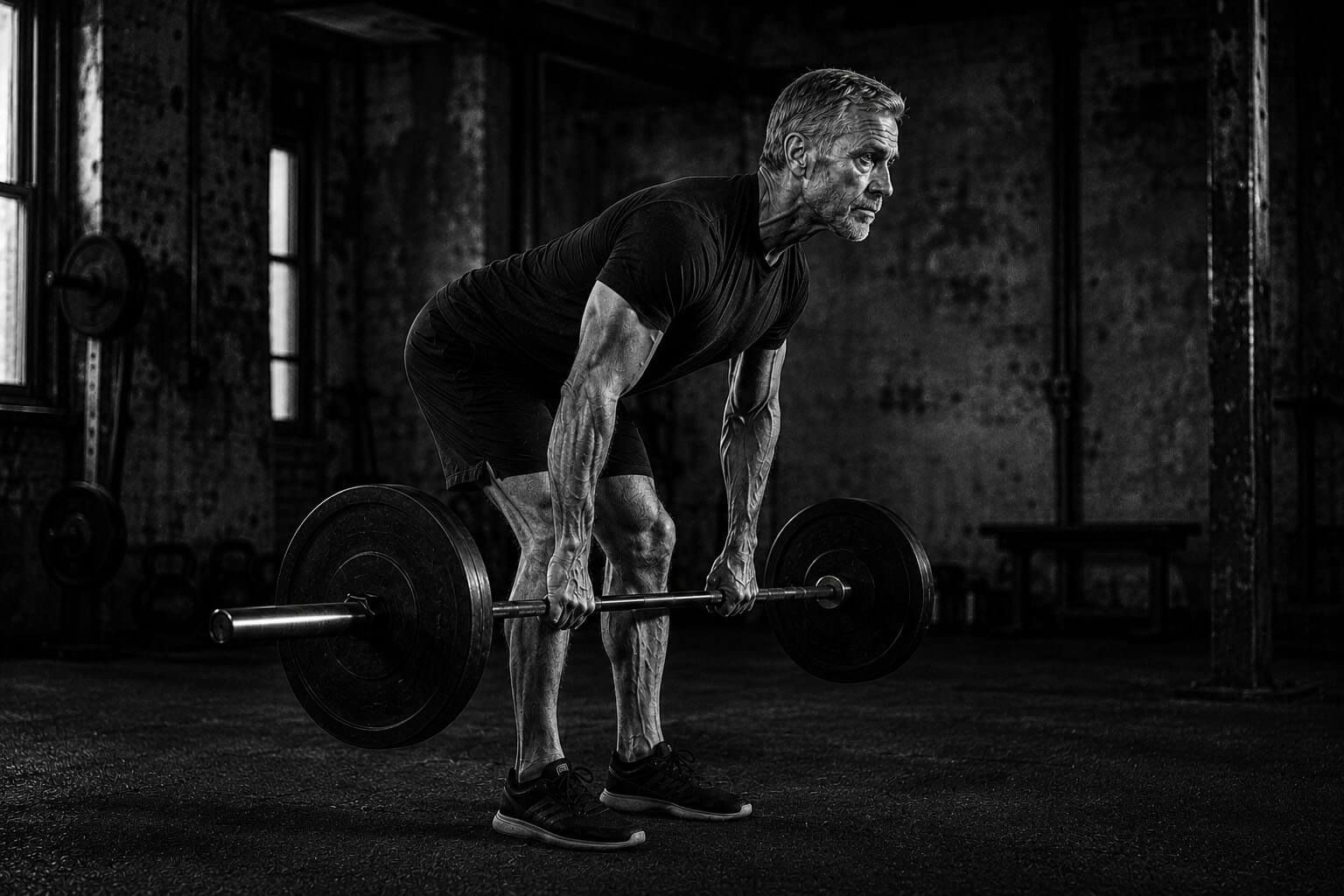
Man lifting a barbell in a gym, preparing to lift. Black and white.
By Craig McBreen January 13, 2026
Afraid of deadlifts after 50? This guide shows you how to safely master the "pick up anything" exercise that builds strength, bone density, and prevents injury.
By Craig McBreen July 30, 2025
Get Fit After 50: Discover These Free eBooks to Build Strength, Boost Metabolism, and Stay Active. And...
A man is lifting a barbell over his head in a gym.
By Craig McBreen June 17, 2025
You can create a simple plan to get in shape without confusion or feeling overwhelmed. Here’s a simple, sustainable way to start exercising and...
By Craig McBreen June 13, 2025
I’m 61, a NASM-certified personal trainer, and lifting weights has completely changed my life! I move better, look better, feel better, and get a lot more done. Midlife isn’t the end. Nope! It’s your launchpad to build strength, lose weight, and feel better. But myths about fitness after 50, like “you’re too old” or “you’ll get hurt,” drain your drive and keep you trapped in a rut, missing out on the life-changing power of exercise. These lies whisper doubt, making you think strength and vitality are out of reach. BUT they’re not! Getting fit can transform your energy, confidence, and independence, and I’m here to help you break free and start moving. I love debunking these lies and defying aging stereotypes. It’s why I do what I do! My ethos? Stronger. At. Any. Age. Strength has no expiration date, and I’m here to help you rewrite the rules of aging. So, let’s crush five big fat myths with facts, simple steps, and actionable tips to get you moving today. Why Myths About Fitness After 50 Hold You Back Myths about aging and exercise aren’t just wrong. They’re soul-crushing. Honestly… they are! They plant doubts like “I’m too old” or “I’ll hurt myself,” making fitness feel risky or pointless. This fear leads to inaction, and that’s when atrophy kicks in. Atrophy sucks, big time. It leaves you with low energy, weaker muscles, achy joints, and a higher risk of chronic conditions. The soreness of a workout? Temporary. The pain of muscle loss? It lingers and drags you down. The truth? Fitness after 50 is transformative, boosting strength, mobility, and mental clarity. Today, let’s ditch the myths and build a fitness habit to change your life. Myth 1: You’re Too Old to Start Exercising Truth: You’re never too old to get fit and strong. Research highlighted in Men’s Health shows that older adults, even those with mobility issues, can improve strength and reduce disability risk by about 20% through regular resistance training. While muscle growth may be slower after 50, your body still responds to exercise, building strength and boosting mobility to keep you thriving. Action Step : Just start! Try bodyweight exercises like chair squats (10 reps, 2 sets) or wall push-ups. Progress to light dumbbells (3-5 lbs) for bicep curls. Aim for 2-3 sessions per week, 20 minutes each. Need a warm-up? Check out my free eBook, Your Dynamic 50+ Warm-up Guide , with 15 active stretches to prep your body for strength training. Myth 2: You’ll Get Injured if You Exercise Truth: Exercise is safer than sitting still, and older adults recover better than you think. A study in the Journal of Aging and Physical Activity, cited in Parade , found that "older adults didn’t lose more muscle function than younger adults.  In fact, after 48 hours, their muscle soreness was about two-thirds lower, and after 72 hours, it dropped to just one-third of what their younger counterparts experienced." And, “These findings are significant because they challenge the widespread belief that aging muscles recover more slowly or are more prone to exercise-induced damage." Atrophy aches worse than any workout—trust me, I train people over 50, and the mild discomfort of lifting beats the lingering pain of muscle loss every time! Action Step : Over 50? 60? Just start! Try push-ups, bodyweight squats, or a cheap set of dumbbells. Train 2-3 times a week, 15-20 minutes. On off days, walk to boost your step count, bike, hike, or even run. Keep it simple to build the fitness habit. Not sure where to begin? Read my guide on getting fit after 50: Fit, Strong, and Lean After 50 . Myth 3: It’s Too Late to Build Muscle Truth: You can pack on muscle even in your 70s and beyond. A 2023 study in Frontiers in Physiology, featured in Men’s Health , found that untrained men in their 70s and 80s built muscle just as effectively as lifelong athletes after a single resistance workout, proving it’s never too late to get stronger. The site mentioned 78-year-old Ernie Hudson, who looked amazing for his age. Age may slow testosterone, but smart training—like heavy compound lifts—sparks growth and keeps you thriving. Action Step : Grab some resistance bands or dumbbells for seated rows (8-10 reps, 2 sets). Eat 0.5-0.7g of protein per pound of body weight daily (e.g., 75g for a 150-lb person) to fuel muscle repair. Want to start with dumbbells? My free eBook, Dumbbell Fitness Made Simple , offers easy, effective exercises to kickstart your routine. Download it now—no email needed. Myth 4: You Need Intense Workouts to See Results Truth : Moderate, consistent exercise is the key. The CDC recommends 150 minutes of moderate activity weekly for older adults, like brisk walking or light weightlifting. People get excited, jump in, burn out, and fizzle. NOT good! Good habits eat motivation for breakfast. Start small, build a routine that fits your life, and after 30+ days, it becomes part of your day. Action Step : Walk 20 minutes daily at a good pace. Add one full-body dumbbell workout weekly (e.g., squats, chest presses, rows; 10 reps each, 2 sets). Try push-ups, bodyweight squats, or light dumbbells 2-3 times a week. Off days? Walk, bike, or hike. Need inspiration? Read, Fit, Strong, and Lean After 50 . My little ebook shares five steps to revive your metabolism and build muscle. Myth 5: Fitness Won’t Improve Your Quality of Life Truth: Regular exercise transforms how you feel and live, especially as you age. This study found that men over 65 who exercised at least 45 minutes three times a week scored significantly higher in life satisfaction, self-esteem, and self-efficacy compared to those who didn’t exercise. Getting fit isn’t just about lifting weights. It IS about climbing stairs with confidence, carrying groceries like a pro, and feeling unstoppable at any age. Action Step : Kick off your day with a quick 10-minute routine: 5 minutes of stretching (think arm circles or leg swings) and 5 minutes of bodyweight moves like sit-to-stands. Track how your energy and mood improve each week. My Journey and Expertise At 61, I’m proof that fitness after 50 changes everything. As a NASM-certified trainer, I turned my health around after battling low energy and joint pain in my 50s. I shifted from a cardio-heavy routine in my 40s to strength training and smart nutrition in my 50s. The secret? Small, daily actions pave the way for lasting results that will improve your life! Take Control of Your Fitness Today. Forget what they told you—midlife is your time to shine. YEP, you CAN build strength, lose weight, and feel AMAZING. So, get after it! The key to getting fit? Build the fitness habit. Start small with workouts you enjoy, stay consistent, and watch your life change. Let’s rewrite the rules of aging together. Resources: Check out my eBooks, guides , and tools to help you get fit, strong, and lean after 50.
A man is lifting a barbell in a gym.
By Craig McBreen June 3, 2025
Aging doesn’t mean slowing down. No, far from it! With the right approach, you can rebuild your body, boost your metabolism, and live stronger.
A row of dumbbells are lined up on a rack in a gym.
By Craig McBreen March 9, 2025
Everyone, regardless of age, should incorporate some form of muscle-strengthening activities into their routine...
A man is lifting a barbell in a gym in a black and white photo.
By Craig McBreen February 27, 2025
Why should men over 50 in Fort Collins (or anywhere) make strength training a priority? Let’s break it down in this post and...