How to Start Lifting Weights at 55: 12-Week Beginner Roadmap
Is It Safe to Start Lifting Weights at 55?
Yes! Lifting weights is one of the safest, most effective things a man over 55 can start, as long as you begin light, learn the movements first, and add weight slowly over 12 weeks.
I know because I did it.
I was 240-ish pounds in my 30s and into my 40s.
Then I went the other way. Thin, weak, and obsessed with treadmill miles that went nowhere.
Chronic back pain was my constant companion. Some mornings my back locked up when I bent over to tie my shoes.
In my mid-50s, I finally got with the program. Strength training. Protein first. Real recovery.
At 59, I got certified as a personal trainer through NASM. Not as a hobby. As a conclusion.
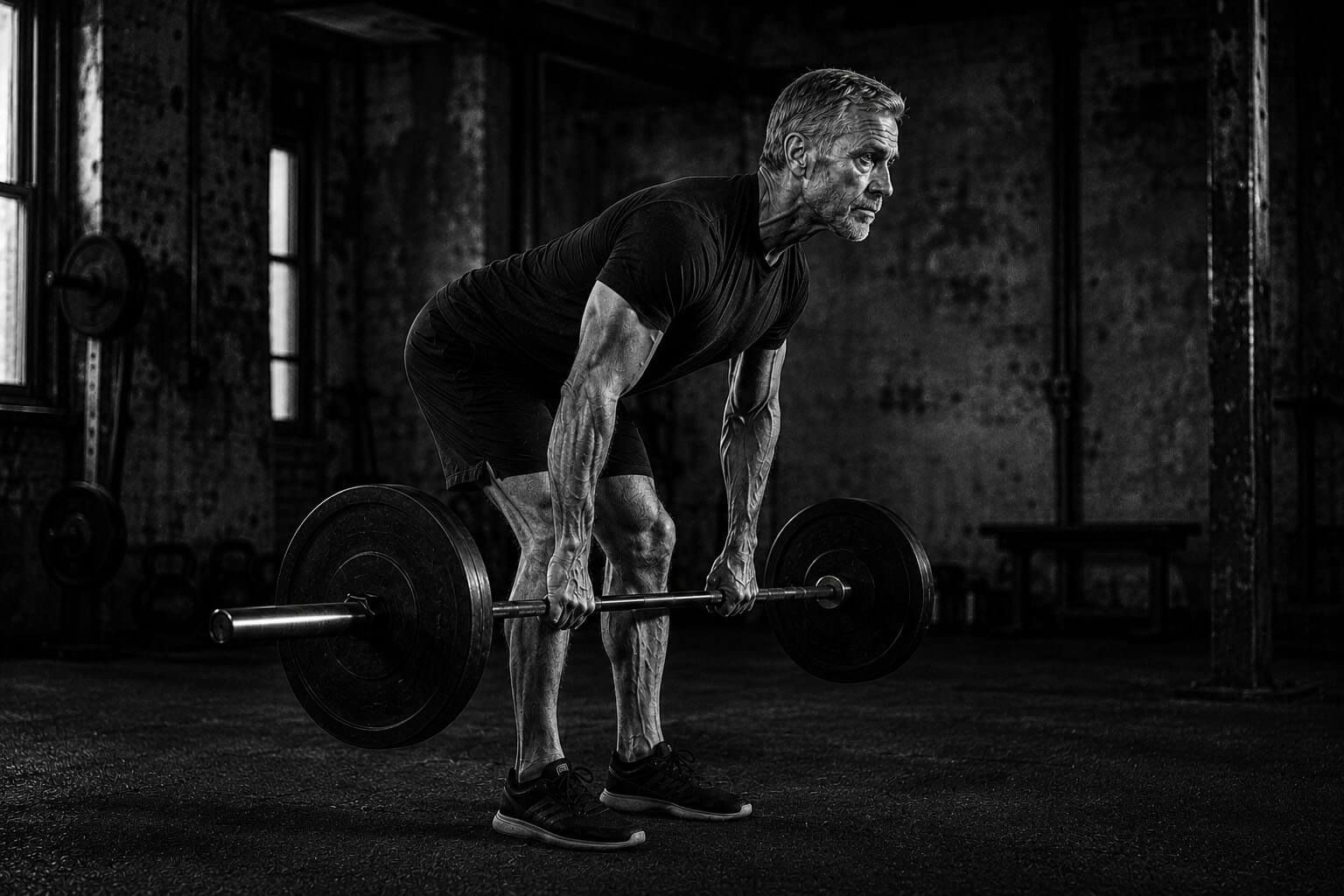
At 62, I'm stronger and leaner than I was at 32.
Can You Build Muscle After 50?
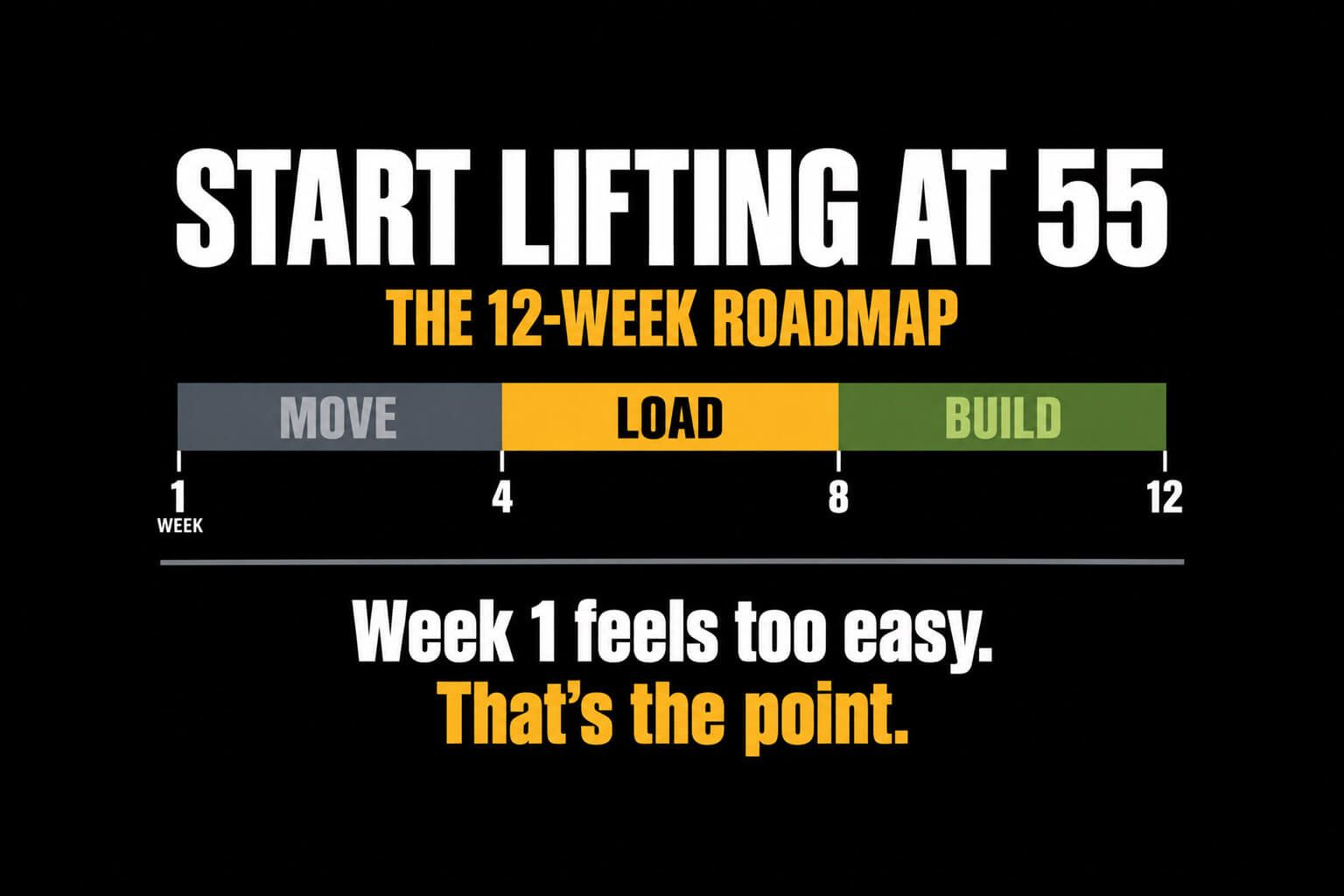
YES! And this is the roadmap I wish someone had handed me at 55. Twelve weeks.
Three phases. Four weeks each. It's the same phased structure I use with the men I coach online.
What can you realistically expect in 12 weeks?
| Timeline | Real Progress & Adaptation |
|---|---|
| Week 4 | You move better. Squats, hinges, pushes, and pulls feel natural. Strength climbs fast as your nervous system learns the movement patterns. |
| Week 8 | Every lift is measurably heavier than Week 1. You recover faster between sessions and experience less residual soreness. |
| Week 12 | Clothes fit differently and your waist is smaller. Strength training is now an established weekly habit rather than a project. |
You won't look like a magazine cover model with a six-pack in 12 weeks.
That's not the goal.
My main goal for you isn't a number on the scale.
It's that the habit is built and it runs without you thinking about it.
What Should You Check Before Your First Workout at 55?
Get your doctor's clearance if you have heart, blood pressure, or joint issues. Learn the difference between discomfort and pain. Warm up every single session.
Every client I take on fills out the PAR-Q+, a standard health screening questionnaire, before we lift anything. If it flags something, we get physician clearance first. Do the same for yourself.
Stop and call your doctor if you feel any of these during training: chest pain, pressure, or tightness. Dizziness or faintness. Shortness of breath that's out of proportion to the effort. Numbness or tingling running into an arm or leg.
Pain or discomfort? How to tell the difference
I learned this one the hard way. Years of pounding miles on a cranky back taught me that pushing through pain doesn't build anything. It just breaks your body.
| What You Feel | What It Means | What to Do |
|---|---|---|
| Burning in the working muscle | Effort | Keep going |
| Soreness 24 to 48 hours later | Normal adaptation | Train, maybe a little lighter |
| Dull stiffness that fades as you warm up | Usually fine | Watch it |
| Sharp, pinching, or joint pain | A stop signal | Stop. Swap the exercise. |
| Pain that's worse the next morning | Too much, too soon | Lower the weight next session |
A simple rule: on a 0 to 10 scale, pain at 3 or below that settles by the next morning is usually fine. Above that, change something.
Your baseline mobility check
Can you sit down to a chair and stand back up without using your hands? Get down to the floor and back up? Raise both arms overhead without arching your low back? If any of those are hard, good. Now you know where Phase 1 starts.
The 6-minute warm-up:
Do this before every session:
- Walk or bike easy for 3 minutes
- Open the book stretch, Hold for 30–60 seconds per side and perform 3–4 sets
- Cat-cow, 8 reps
- Arm circles, 10–15 seconds of circles each direction.
- Inchworm stretch, 5-8 reps
- 90/90 hamstring stretch, 5–10 reps each leg
- Band pull-aparts, 15 reps
- Glute bridges, 12-15 reps
- Bodyweight squats to a box, 8 reps
Then do 1 or 2 light sets of your first exercise before your working sets.
Download your Dynamic 50+ Warm-up Guide for the exercises above and more.
Weeks 1 to 4: How Should a Beginner Over 55 Start Lifting Weights?
Phase 1 goal: Master four movement patterns, squat, hinge, push, and pull, using bodyweight and light dumbbells. Train 2 full-body days a week with at least 48 hours between sessions.
This phase will feel too easy. That's the point.
Here's the physiology. Your muscles adapt faster than your tendons and ligaments. Connective tissue gets stronger through collagen synthesis, and that process runs slower after 50. Load it too fast, and the muscle is ready before the tendon is. That's where beginners over 55 get hurt.
The good news? Most of your strength gains in the first few weeks come from your nervous system learning the movement. You get stronger fast without heavy weights. Trust me. It works!
I spent years focusing on pushing myself to the limit. If I wasn't drenched, it didn't count. Phase 1 breaks that habit. Slow and steady and build the habit.
Remember... the GOAL is that the HABIT IS BUILT and it runs without you thinking about it.
Schedule: Monday and Thursday, or Tuesday and Friday. Walk every day. Add an easy 15-minute mobility session on a third day if you want it.
Phase 1 workout (do the same workout both days)
| Pattern | Exercise | Sets x Reps | Effort (RPE) | Coaching Cue |
|---|---|---|---|---|
| Squat | Goblet squat to a box or bench | 2 x 10 | 5 to 6 | Sit back to the box, stand up tall |
| Hinge | Light dumbbell Romanian deadlift | 2 x 10 | 5 to 6 | Hips back, soft knees, flat back |
| Push | Incline push-up, hands on a bench | 2 x 8 to 12 | 5 to 6 | Body in one line, chest to the edge |
| Pull | Chest-supported dumbbell row | 2 x 10 | 5 to 6 | Elbows to your back pockets |
| Glutes | Glute bridge | 2 x 12 | 5 | Squeeze at the top, ribs down |
| Core | Dead bug | 2 x 6 per side | 5 | Low back stays flat on the floor |
| Carry | Farmer carry | 2 x 30 seconds | 6 | Tall, slow, shoulders back |
Rest 60 to 90 seconds between sets. Take 3 seconds to lower every rep. RPE 5 to 6 means you could do 4 or more reps when you stop. In weeks 3 and 4, add a third set to the first four exercises if you're recovering well by the next session.
Notice what's missing. No lunges. No single-leg work. Two feet on the ground first. Single-leg work starts in Phase 2.
Joint swaps: if it hurts, change the exercise, not the goal.
Knees cranky on squats? Squat to a higher box, or use the leg press with a shorter range.
Low back talking during deadlifts? Stop the dumbbells just below your knees, or swap in a cable pull-through.
Barbell back squats hurt your back? Goblet squats or the leg press load your legs without loading your spine the same way.
Shoulders pinch on push-ups or presses? Raise the incline, turn your palms to face each other, or switch to a landmine press.
Wrists hurt on push-ups? Hold dumbbell handles so your wrists stay straight.
Pain that disappears when you change the exercise is information, not a reason to quit.
Weeks 5 to 8: When Should a Beginner Over 55 Start Adding Weight?
Phase 2 goal: Add weight using progressive overload and move to 3 full-body sessions a week. Rate every set with RPE and leave 2 to 3 reps in the tank.
This is the phase that changed my thinking. For years I measured workouts in miles and sweat with cardio. And when I did touch weights I started heavy and there was zero structure. The number that matters is the weight going up, month after month.
How does progressive overload work after 55?
Use double progression. Pick a rep range, say 8 to 12. Start with a weight you can lift for 8 clean reps. Each session, try to add a rep. When you hit 12 on every set with good form, add the smallest jump available, usually 2.5 to 5 pounds per dumbbell. Drop back to 8 reps and climb again.
No guessing!
What is RPE, and how hard should you push?
RPE stands for rate of perceived exertion. It's how you gauge effort without a coach standing next to you.
| RPE | What It Feels Like | Reps Left in the Tank |
|---|---|---|
| 5 to 6 | Warm-up hard | 4 or more |
| 7 | Hard, form stays sharp | 3 |
| 8 | Very hard, last reps slow down | 2 |
| 9 | A grind | 1 |
| 10 | Nothing left | 0 |
In Phase 2, live at RPE 7 to 8. No 10s. You build more muscle by showing up fresh three times a week than by burying yourself once.
How many days a week should a 55-year-old beginner lift in phase 2?
Three, with a rest day between each. After a session, your muscles stay in rebuild mode for a day or two. After 55, that window runs longer, partly because of anabolic resistance, your muscles' weaker response to training and protein with age. Monday, Wednesday, Friday gives each session room to land.
Phase 2 workouts (alternate A and B)
Week 5 runs A, B, A. Week 6 runs B, A, B. Keep alternating.
| Day | Exercise | Sets x Reps | RPE |
|---|---|---|---|
| A | Goblet squat | 3 x 8 to 12 | 7 to 8 |
| A | Dumbbell Romanian deadlift | 3 x 8 to 12 | 7 to 8 |
| A | Low-incline dumbbell bench press | 3 x 8 to 12 | 7 to 8 |
| A | Lat pulldown | 3 x 8 to 12 | 7 to 8 |
| A | Pallof press | 2 x 10 per side | 6 to 7 |
| B | Leg press | 3 x 10 to 12 | 7 to 8 |
| B | Split squat, holding support | 2 x 8 per side | 7 |
| B | One-arm dumbbell row | 3 x 10 per side | 7 to 8 |
| B | Landmine press or dumbbell shoulder press | 3 x 8 to 12 | 7 to 8 |
| B | Loaded glute bridge or hip thrust | 3 x 10 to 12 | 7 to 8 |
| B | Farmer carry | 3 x 40 seconds | 7 |
The split squat is your first single-leg exercise. Hold a rack or bench for balance if you need to.
Weeks 9 to 12: How Does a Man Over 55 Build Muscle and Make It Stick?
Phase 3 goal: Build muscle by adding volume where you recover well, track progress every week, and turn the program into a routine you run for years. Three lifting days plus one mobility day.
Sarcopenia, age-related muscle loss, picks up speed after 50. Strength training is the most effective tool we have to reverse it. Phase 3 is where you stop learning to lift and start building muscle.
How much volume does a beginner over 55 need?
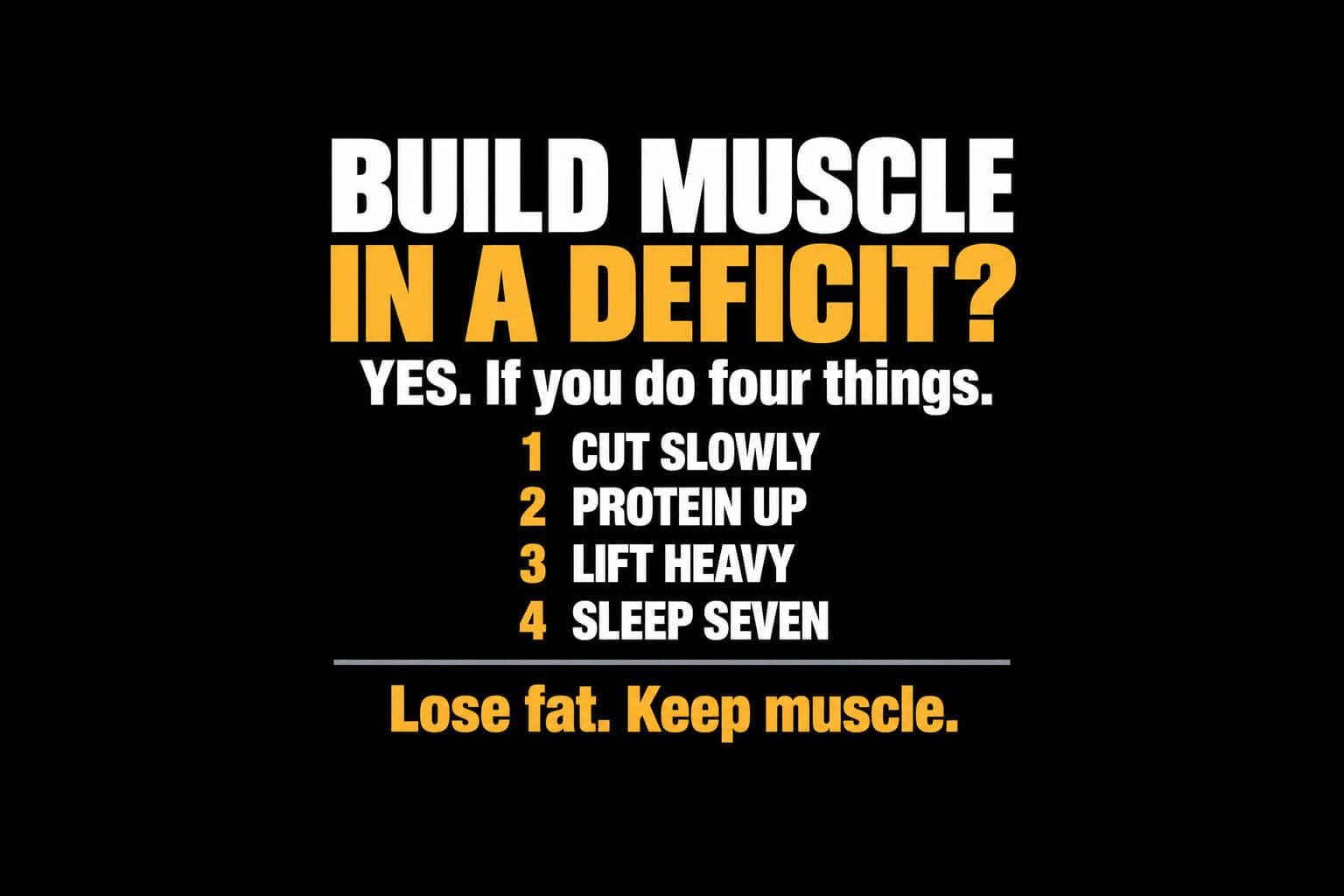
While research suggests targeting roughly 10 hard sets per muscle group weekly for muscle growth, older beginners should focus on the minimum effective dose. Add volume only where recovery is sufficient and hold steady where it is not.
Phase 3 workouts
| Day | Exercise | Sets x Reps | RPE |
|---|---|---|---|
| Mon | Goblet squat or leg press | 3 x 6 to 10 | 7 to 8 |
| Mon | Dumbbell bench press | 3 x 6 to 10 | 7 to 8 |
| Mon | Chest-supported dumbbell row | 3 x 8 to 12 | 7 to 8 |
| Mon | Split squat | 2 x 8 per side | 7 to 8 |
| Mon | Dumbbell curl | 2 x 10 to 15 | 8 |
| Wed | Trap bar deadlift or dumbbell Romanian deadlift | 3 x 6 to 10 | 7 to 8 |
| Wed | Lat pulldown | 3 x 8 to 12 | 7 to 8 |
| Wed | Landmine press or dumbbell shoulder press | 3 x 8 to 12 | 7 to 8 |
| Wed | Hip thrust | 3 x 8 to 12 | 7 to 8 |
| Wed | Cable triceps pushdown | 2 x 10 to 15 | 8 |
| Fri | Leg press | 3 x 10 to 15 | 7 to 8 |
| Fri | Incline dumbbell press | 3 x 8 to 12 | 7 to 8 |
| Fri | One-arm dumbbell row | 3 x 10 per side | 7 to 8 |
| Fri | Low box step-up | 2 x 8 per side | 7 |
| Fri | Suitcase carry | 3 x 30 seconds per side | 7 |
| Sat | Mobility: hips, upper back, shoulders | 20 to 30 minutes | Easy |
That Saturday mobility day isn't a warm-up tax. In my programs, mobility is a pillar. It's what keeps you training at 65 and 70.
Week 12 is a reassessment week. Drop one set from every exercise. Retest your week 1 movements. Take your measurements. Then plan the next block before progress stalls, not after.
What should you track every week?
A single number is noise. The pattern over time is the information.
| Measure | How Often | Why It Matters |
|---|---|---|
| Weights and reps | Every session | Proof you're getting stronger |
| Morning bodyweight | Daily, read as a weekly average | One weigh-in lies. The average doesn't. |
| Waist measurement | Weekly | Shows fat loss the scale misses |
| Progress photos | Weeks 1, 6, and 12 | You see what the mirror hides day to day |
| Sleep and energy, 1 to 10 | Weekly | Your early warning for poor recovery |
What happens after week 12?
You don't start over. You start the next phase, a little heavier and a lot smarter. I'm 62 and I still lift every week. Not because I'm disciplined. Because it's built into my week the same way brushing my teeth is.
How Much Protein Does a Man Over 55 Need to Build Muscle?
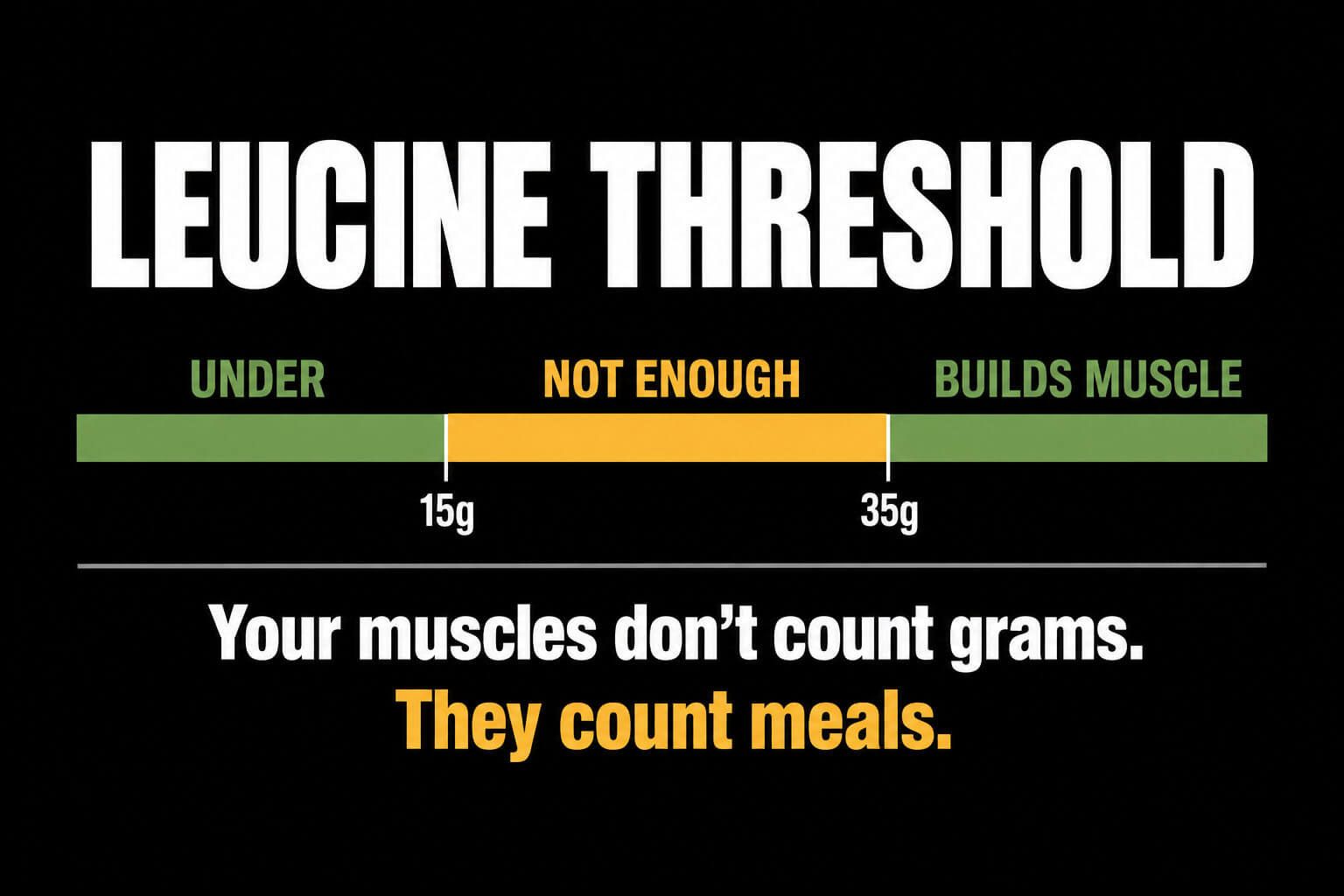
To hit your protein target, aim for 0.7 to 1 gram of protein per pound of goal bodyweight a day, split across 3 or 4 meals of 30 to 40 grams each. Older muscle needs more protein per meal to respond.
That's anabolic resistance again. A 25-year-old can build muscle off a 20-gram serving. After 55, your muscles need a bigger dose at each meal to flip the switch on muscle protein synthesis. Most men I meet are eating about half what they need.
I was one of them. These days I weigh 185 pounds and aim for 165 to 185 grams of protein a day. I track it every day. And I don't count collagen toward that number. It's not a complete protein, so it doesn't build muscle the way meat, eggs, fish, or dairy do.
Four rules that make protein automatic
- Make protein the default in your kitchen. Chicken, eggs, Greek yogurt, cottage cheese, canned tuna and salmon.
- Have one protein shake a day.
- Snacks are protein or fruit. Nothing else.
- Build every meal around protein plus a vegetable.
Water and sleep count too
Your thirst signal weakens with age, so don't wait until you're thirsty. Drink water with every meal and around every workout. Pale yellow is the target.
Sleep is when the rebuilding happens. Seven to nine hours isn't a luxury. It's part of the program.
If you have kidney disease or another medical condition, check your protein target with your doctor first.
Where Do You Start?
Start with where you stand today. Twelve weeks from now, you'll be stronger on every lift, moving better, and running a habit you can keep for decades.
At 55, I didn't need more motivation. I needed a plan with fewer decisions in it. That's what this roadmap is.
Your second half is not a decline. It is a rebuild.
Before the plan comes the score.
Takes 2 minutes. Completely free.
If you'd rather have someone build and rebuild this with you off your real numbers, that's what my online strength coaching for men over 50 does.
Craig McBreen is a NASM-Certified Personal Trainer and founder of
FiftyPlus Fitness. He started strength training in his mid 50s, got certified at 59, and at 62 is stronger and leaner than he was at 32.