You Hit Your Protein Target and Still Aren’t Gaining Muscle
Why?
You’re a 55-year-old guy, 195 lbs, lifting and tracking food.
Two eggs and two slices of turkey bacon for breakfast. Yogurt late morning. A big ol’ turkey deli sandwich at lunch. A large chicken breast and greens for dinner.
Add it up, and you’re at roughly 130 grams of protein for the day. Not bad.
But you still feel soft, like you’re not gaining muscle.
I lived this. At 36, I was 240 lbs and honestly never focused on protein.
In my 40s, I lost weight, became addicted to running, and my protein was lunch meat, pizza, burgers with gobs of mayo, ketchup, and cheese. I kinda sorta paid attention to protein but didn’t really know how to eat it right.
All that running and I still got softer every year.
In my early 50s, I finally got the message. I did what you’re doing. Spread it out, protein snacks, chicken almost every night.
Good instinct. BUT suboptimal delivery.
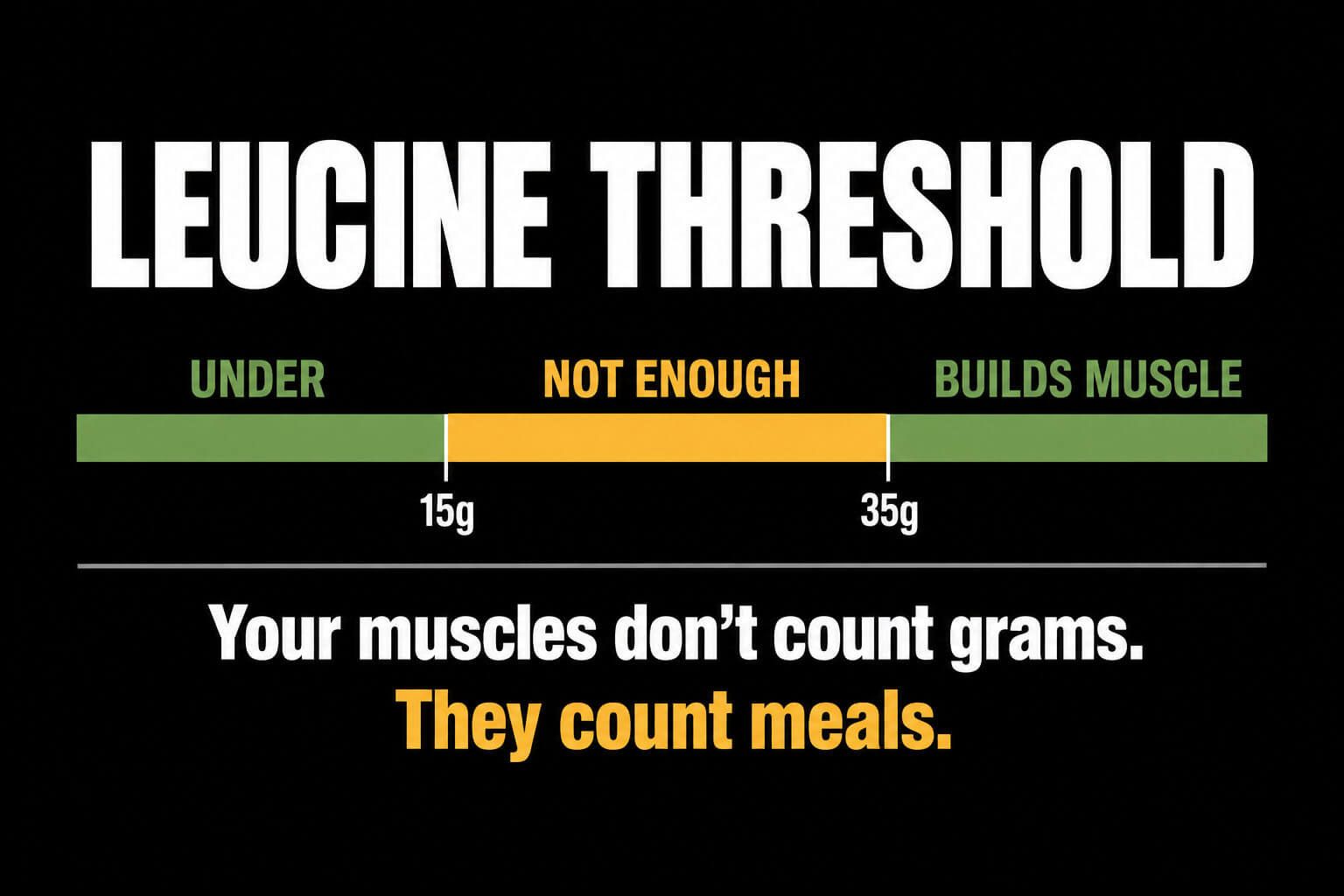
Your muscles don’t count grams. They count meals.
There’s a process called muscle protein synthesis, or MPS.
It’s the process that takes protein you eat and turns it into muscle tissue.
Your body is always breaking down and rebuilding muscle tissue to keep it healthy. MPS is the rebuilding side, and it never fully stops.
BUT that background rebuilding doesn’t build muscle. The spike builds you. And it primarily fires in response to two things: a protein-rich meal or a resistance training session.
With food, the spike only happens if you eat enough protein at one time. A small meal leaves the system asleep. A real meal delivers the loud response you need.
Each spike lasts a few hours, then drops, which is why one massive protein dinner won’t cover you for the day.
Think of a light switch.
You don’t get 50 percent light by flipping it halfway. It’s off, or it’s on. You either cross the threshold or you don’t.
The thing that flips that switch? An amino acid called
leucine.
Leucine is in most protein. It’s the concentration that varies. Animal protein runs 8-10 percent leucine. Whey is the highest at around 11%. Plant sources run lower, which is why they need more volume to do the same job.
But your meal has to deliver enough of it in one sitting. 15 grams of protein at breakfast gives you roughly 1.2 grams of leucine. You need 2.5 to 3.
So, you get a weaker response. The protein isn’t wasted, but most of it goes to everyday maintenance and energy rather than building anything new. You ate well. You just didn’t build as you could have.
Go back to the breakfast I described at the beginning. Two eggs and two slices of turkey bacon are roughly 18-20 grams of protein, which gives you about 1.5 grams of leucine. You thought it was a solid protein-first meal. It wasn’t. You came up short on the number that mattered.
After 50, the switch gets harder to flip
At 30, your switch is sensitive. Meaning, 20 grams of protein in a meal will easily flip it.
At 60, it takes more. Your muscle is less responsive to the signal because of something we call
anabolic resistance. Same food and protein, but a weaker response.
Anabolic resistance is real and measurable. But you can fight it.
How much do you need?
Aim for 2.5-3 grams of leucine per meal.
For most high-quality animal protein, leucine runs about 8-10% of total protein. So that means you need to eat about 35-40 grams of protein in a meal.
Eat 35 grams of protein, and you get about 3 grams of leucine, which does it. 15 grams of protein and you get 1.2, which does not.
You're not counting leucine. You ARE counting protein. Just focus on eating 35-40 grams of protein in a single meal, and the leucine takes care of itself.
AND… do this 3-4 times a day.
Your leucine plan…
Eat meals, not snacks. The two eggs at 9 am and yogurt at 11 are each too small to change anything.
Fix breakfast first. This is where almost everyone fails. Coffee and toast. A small yogurt cup. Two eggs. Do this, and the switch stays off until lunch. Breakfast is the easiest meal to fix. Try this: Four eggs and a cup of cottage cheese. Or two eggs, two slices of toast, and a scoop of whey in coffee.
Whey is your shortcut. Whey isolate is unusually high in leucine, higher than almost any whole food. One scoop on top of a meal that got you 25 grams is the simplest fix there is.
Plant-based means more volume. Plant proteins carry less leucine per gram. If you eat that way, you’ll need noticeably more total protein per meal to hit the same trigger, or you will need to lean on a fortified protein powder. This is worth planning around rather than hoping.
Lift. This is the multiplier, and it’s not optional.
Strength training forces your muscle cells to wake up and pay attention to the food you consume.
Here’s the thing that should change how you think about your week.
Strength training raises how responsive your muscles are to protein, and the responsiveness stays elevated a day or more afterward. Train! Then pair it with a protein goal that actually flips the switch. You’ll get a growth response that neither training nor eating can produce alone.
And yes, this matters on your rest days too. Training opens the growth window, but your muscles spend the next 48 hours recovering and rebuilding. If you drop your protein on an off day, you leave the construction site with no raw materials. Together they compound.
And this works.
You can build muscle at any age. People in their seventies and eighties put on measurable muscle in controlled studies when they lift and eat enough protein. Yeah, your ceiling is lower than a 25-year-old’s. BUT your capacity to build is NOT GONE!
At 62, I’m honestly stronger and leaner than I was at 32. Not because I was super disciplined. It happened because I stopped doing the wrong things and started doing the right things. Eating more high-quality protein was one of the right things!
Foods that hit the target
- Whey isolate, 2 scoops
- Chicken breast, 5-6 ounces
- Beef, 5-6 ounces
- Salmon, 6+ ounces
- Greek yogurt, 1 cup, plus a scoop of whey or a half cup of cottage cheese
- Tuna, 1 can, plus two eggs or a slice of cheese and a cup of milk
About eggs. 2-3 eggs is a common breakfast, but that’s only 12-18 grams of protein. Great food but not enough on its own. Add Greek yogurt or cottage cheese. Add a scoop of powder, or just cook three more eggs.
The real takeaway
You probably don’t have a total protein problem, you have a meal-timing problem.
Stop asking what you ate today and start asking whether any single meal today was big enough to build anything.
Most people over 50 have only one meal a day that triggers growth. Dinner! That means you are missing out on two to three other opportunities every single day. Fixing breakfast alone can double your muscle-building potential, and it costs you nothing but a simple shift in your morning routine.
Curious where you stand?
Take the Strength Score. It takes two minutes, and it maps your protein, sleep, stress, and training against what your body needs after 50. You’ll get a number and a straight read on which of those is quietly costing you the most.
Completely free: Get Your Strength Score.
Craig McBreen is a NASM-Certified Personal Trainer and founder of
FiftyPlus Fitness. He started strength training in his mid 50s, got certified at 59, and at 62 is stronger and leaner than he was at 32.